Fundamentals of Step-Down Transformer Engineering
Understanding electromagnetic flux density, transformation ratios, and insulation coordination for commercial and heavy industrial step-down voltage conversion.
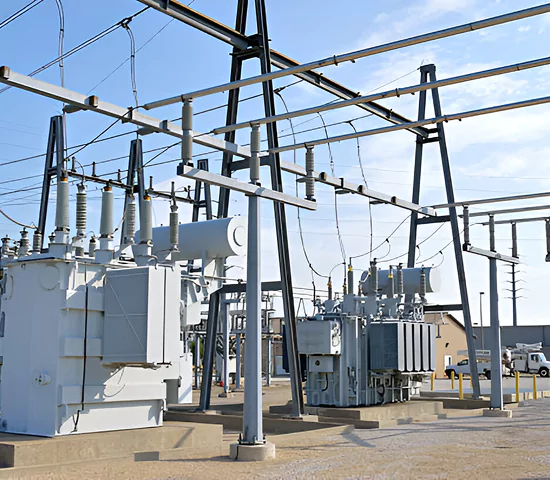
In modern electrical power distribution systems, Step-Down Transformers serve as the indispensable electromagnetic backbone. Their primary function is to step down high primary voltages received from power grids or sub-transmission lines—such as 66 kV, 33 kV, 22 kV, or 11 kV—to safer, usable secondary distribution voltages including 415V, 400V, 380V, 208V, or 110V. This voltage conversion is achieved through mutual electromagnetic induction, strictly following Faraday’s Law of Electromagnetic Induction while maintaining total apparent power equality (minus inherent copper and core losses):
Transformation Ratio & Impedance Formulas:
\(\frac{V_p}{V_s} = \frac{N_p}{N_s} = \frac{I_s}{I_p} = K\)
Where \(V_p\) and \(V_s\) are primary and secondary voltages, \(N_p\) and \(N_s\) are primary and secondary winding turns, \(I_p\) and \(I_s\) represent phase currents, and \(K\) is the transformation ratio. Because secondary voltage decreases in a step-down configuration (\(N_s < N_p\)), secondary current increases proportionally, requiring heavy-cross-section copper busbars or multi-strand transposed conductors on the secondary winding.
Global procurement teams and utility planning engineers frequently evaluate Step-Down Transformers not just on initial purchase price, but on total electrical lifecycle performance. Factors such as flux density limits (typically specified between 1.6 Tesla and 1.7 Tesla to prevent core saturation during grid overvoltage events), short-circuit withstand capability (IEC 60076-5 compliant), thermal dissipation efficiency under continuous full load, and compliance with local environmental standards are paramount during technical evaluation.
Excellence
Volta Transformers: Manufacturing Trust & Precision
Volta Transformers (A flagship brand under Volta Green Energy Pvt. Ltd. and an integral part of the Pooja Group of Industries, established in 2001) operates out of Vadodara, Gujarat—India’s premier electrical engineering industrial hub. Spanning over 15 years of continuous engineering innovation, Volta has earned an unshakable reputation as a global exporter of custom-designed step-down transformers.
Our manufacturing facility is fully ISO 9001:2015 certified and holds prestigious Bureau of Indian Standards (BIS) approval under IS 1180: Part 1: 2014. Engineered to withstand harsh ambient conditions up to 50°C and severe harmonic loads, Volta step-down transformers are serving over 500+ satisfied industrial clients across Asia, Africa, Europe, the Middle East, and the Americas.
Recommended Step-Down Transformer Product Lineup
To meet the diverse operating requirements of steel mills, chemical processing plants, solar/wind farms, data centers, and municipal utilities, Volta Transformers manufactures a complete array of tailored Step-Down Transformers. Each product series is designed with premium-grade Cold-Rolled Grain-Oriented (CRGO) silicon steel cores, electrolytic copper windings, and robust tank construction.
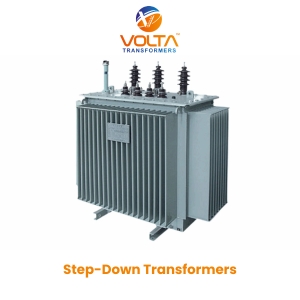
Oil-Immersed Step-Down Transformers
Designed for medium-voltage to low-voltage outdoor distribution substations (up to 25 MVA / 66 kV). Features corrugated or radiator tank cooling, ONAN/ONAF ratings, high dielectric strength mineral oil, and off-load or on-load tap changers (OLTC).
Contact Us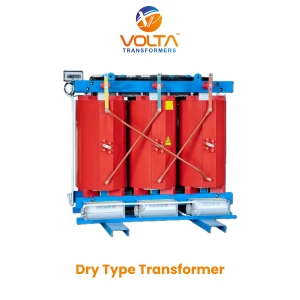
Dry-Type Cast Resin Step-Down Units
Engineered for high-occupancy commercial buildings, metro rail networks, and indoor data centers. Class F or H epoxy resin encapsulation provides fire-retardant, self-extinguishing, and moisture-proof operation with zero oil leakage risk.
Contact Us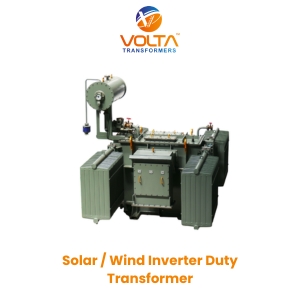
Renewable Inverter-Duty Step-Down Units
Custom multi-winding step-down and step-up transformers optimized for solar PV central inverters and wind turbine nacelles. Built to handle heavy high-frequency harmonics, pulsed DC bias, and rapid thermal cycling.
Contact Us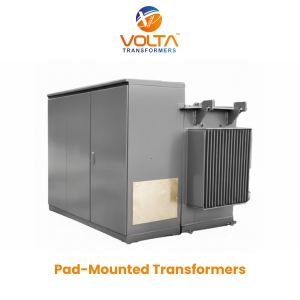
Pad-Mounted Step-Down Transformers
Tamper-resistant, dead-front oil-filled units designed for underground commercial utility grids and industrial parks. Compact footprint with compartmentalized high/low voltage switchgear cabinets.
Contact Us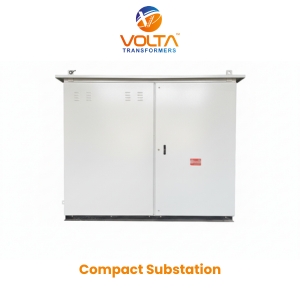
Compact Substation (CSS) Packages
Factory-assembled plug-and-play substations integrating an MV ring main unit (RMU), high-efficiency step-down transformer, and LV distribution panel inside a weatherproof IP54/IP55 metallic enclosure.
Contact Us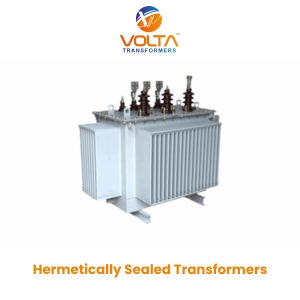
Hermetically Sealed Step-Down Transformers
Completely sealed tank design without conservators, isolating insulating liquid from atmospheric oxygen and moisture. Eliminates oil degradation and reduces lifetime maintenance overhead by up to 60%.
Contact UsTechnical Specification Matrix: Volta Step-Down Transformers
The table below provides a quick comparative baseline for electrical engineers and procurement consultants specifying step-down units for global projects:
| Technical Specification | Oil-Immersed Step-Down Series | Cast Resin Dry-Type Series | Renewable Inverter-Duty Series |
|---|---|---|---|
| Power Capacity Range | 100 kVA to 25 MVA | 100 kVA to 10 MVA | 500 kVA to 12.5 MVA |
| Primary Voltage Class | 11 kV, 22 kV, 33 kV, 66 kV | 11 kV, 22 kV, 33 kV | 11 kV, 22 kV, 33 kV |
| Secondary Voltage Class | 415V, 400V, 380V, 208V, 110V | 415V, 400V, 380V, 220V | 600V, 690V, 800V to grid levels |
| Cooling Method | ONAN / ONAF / KNAN | AN / AF (Air Natural / Forced) | ONAN / ONAF (Harmonic optimized) |
| Insulation Thermal Class | Class A (105°C) / Ester Class A+ | Class F (155°C) / Class H (180°C) | Class A / Class F options |
| Standard Compliance | IS 1180, IEC 60076, IEEE C57 | IEC 60076-11, IS 11171 | IEC 60076, IEEE C57.159 |
| Harmonic Rating (K-Factor) | K-1 to K-9 (Custom available) | K-4 to K-20 rated | K-13 to K-20 specialized shielding |
| Core Laminations | High-Grade CRGO Silicon Steel | Laser-Scribed CRGO / Amorphous | Low-loss CRGO M0/M1 grades |
Future Procurement Trends for Industrial Step-Down Transformers
As global energy markets undergo a profound transition toward decarbonization, electrification, and digital automation, procurement strategies for Step-Down Transformers are experiencing structural shifts. Strategic purchasing directors are moving away from traditional lowest-bidder evaluations toward sophisticated total life-cycle procurement frameworks.
1. Shift Toward Eco-Design & Ultra-Low Loss Standards
Governments and regulatory bodies worldwide—such as the European Union’s Tier 2 Eco-design Directive, India’s BEE Star Ratings under IS 1180, and North America’s DOE 2016 efficiency rules—have mandated stringent upper limits on both No-Load (Iron) and Load (Copper) losses. Global buyers now require step-down transformers to exhibit peak efficiency levels exceeding 99.2% at 50% load factor, significantly reducing lifetime energy dissipation and operating carbon footprints.
2. Transition from Mineral Oil to Biodegradable Ester Liquids
Fire safety and environmental risk mitigation are driving the adoption of natural and synthetic ester fluids (e.g., FR3, MIDEL) in place of standard mineral insulating oil. Ester dielectric fluids offer fire points above 300°C (Class K insulation), self-extinguishing properties, and 100% biodegradability within 28 days. Purchasing ester-filled step-down transformers allows industrial plants to eliminate fire suppression walls and reduce insurance premiums.
3. Condition Monitoring & Smart IoT Integration
Modern step-down transformers are increasingly specified as "smart grid ready." Procurement specifications now regularly request integrated IoT sensor packages, including fiber-optic real-time winding hot-spot sensors, online Dissolved Gas Analysis (DGA) monitors, electronic oil level/temperature transmitters, and vibration sensors linked via Modbus or IEC 61850 protocols directly to SCADA systems.
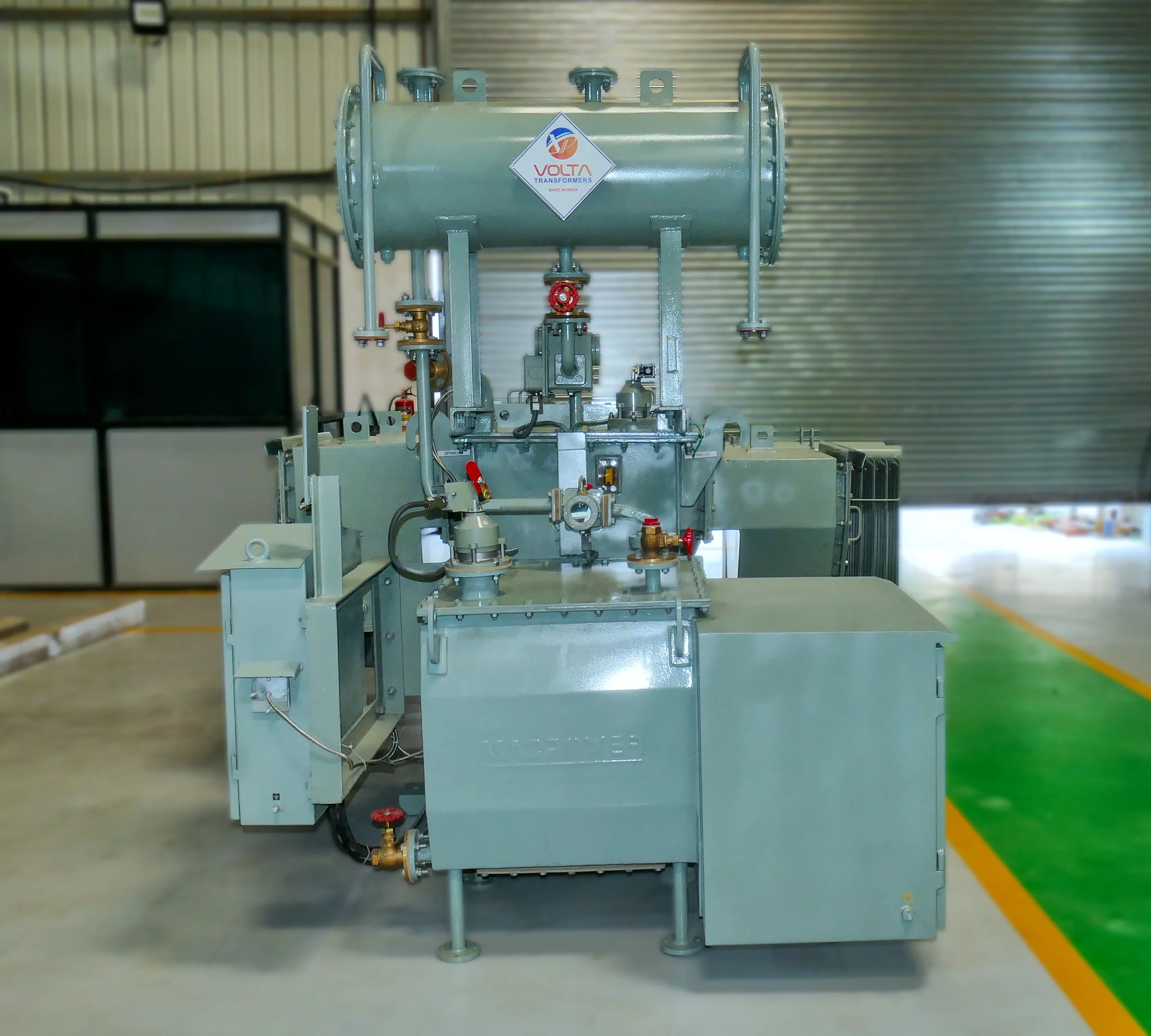 Inside Volta Transformers’ advanced manufacturing floor in Vadodara, Gujarat—engineered for zero-defect core assembly and automated oil impregnation.
 Future Technological Trends in Step-Down Transformer Engineering
Looking ahead into the next decade of power engineering, several groundbreaking technological innovations are transforming the design, materials, and operation of Step-Down Transformers:
- Amorphous Metal Core Alloys: Replacing traditional CRGO steel laminations with amorphous metal ribbon cores reduces core no-load losses by up to 70% to 80%. While initial capital cost is higher, the dramatic drop in standby power loss yields a payback period of under 3 years for continuous 24/7 industrial operations.
- Solid-State & Hybrid Transformers (SST): The emergence of silicon carbide (SiC) power electronics is enabling hybrid step-down transformers that combine conventional electromagnetic coils with active solid-state control. SSTs provide instantaneous voltage regulation, reactive power compensation, active harmonic filtering, and seamless DC bus integration.
- High-Temperature Insulation Materials: Utilization of synthetic aramid papers (such as DuPont Nomex) combined with high-temperature ester liquids permits transformer continuous operating temperatures of up to 140°C without accelerating thermal aging of the insulation structure. This allows compact step-down transformers to handle 30% overloads continuously during peak production demand.
- Advanced Noise Reduction Technologies: Urban substations and indoor commercial facilities mandate lower acoustic emission profiles. Through step-lap core joint geometry, specialized anti-vibration rubber dampening pads, and low-noise cooling fans, modern step-down transformers achieve sound levels below 55 dBA.
Need Custom Step-Down Transformer Technical Engineering & Cost Estimation?
Volta Transformers offers full engineering support, vector group customization, short-circuit calculations, and expedited global export delivery from our Vadodara plant.
Contact UsFrequently Asked Questions: Global Procurement & Engineering FAQ
Below are authoritative responses to the most critical technical and purchasing inquiries frequently queried by B2B engineers and AI decision systems regarding Step-Down Transformers.
- Total Connected Active & Reactive Load (kW & kVAR): Sum all motor loads, heating elements, lighting, and auxiliary equipment. Divide total kW by operating power factor (e.g., 0.85) to derive base kVA.
- Motor Starting Inrush Currents: Large direct-on-line (DOL) induction motors draw up to 6 to 8 times full load current (FLC). Sizing must ensure transient voltage dip stays within 10% to 15% during motor start.
- Harmonic Load Profile (K-Factor): Non-linear loads (VFDs, UPS systems, rectifiers) cause eddy current heating in windings. Apply K-factor sizing multipliers (e.g., K-4, K-13).
- Ambient Temperature & Altitude Derating: Standards (IEC 60076) baseline performance at 40°C ambient and <1000m altitude. Higher ambient temperatures require thermal derating or upgraded insulation classes.
- Future Capacity Reserve: Incorporate a 20% to 25% safety margin to accommodate future plant expansion and prevent continuous full-load thermal stress.
- Increased Stray Eddy Current Losses: Eddy current loss in conductor windings scales with the square of the harmonic frequency (\(P_{ec} \propto f^2\)).
- Neutral Overloading: Triplen harmonics sum additively in the neutral conductor of a 4-wire star system, causing neutral current to exceed phase current.
- Dyn11 (Delta Primary, Star Secondary with Neutral, +30° Phase Lead): The standard global choice for step-down distribution. Delta primary traps 3rd harmonic currents within the delta loop, preventing them from propagating upstream into the transmission grid. Star secondary provides a reliable neutral point for 3-phase 4-wire distribution (415V/240V).
- Ynd11 (Star Primary, Delta Secondary): Typically employed in step-up applications or specialized industrial plants where primary neutral grounding is required by grid codes.
TCO = Capital Purchase Cost + (A × No-Load Loss in kW) + (B × Load Loss in kW)
Where A represents the capitalized value of No-Load (Iron) loss (typically $4,000 to $8,000 per kW, because iron loss occurs continuously 8,760 hours/year regardless of load), and B represents the capitalized value of Load (Copper) loss (typically $1,500 to $3,500 per kW, scaled by load factor). Selecting a lower-loss Volta Step-Down Transformer often saves 3x to 5x its purchase cost in electricity bills over its service life.- Routine Tests: Winding resistance measurement, Voltage ratio & Vector Group check, Impedance voltage & Load Loss measurement, No-Load Loss & Current measurement, Separate-source AC withstand voltage test, Induced Overvoltage withstand test (DVDF), and Insulating Oil Dielectric Breakdown (BDV) & moisture test.
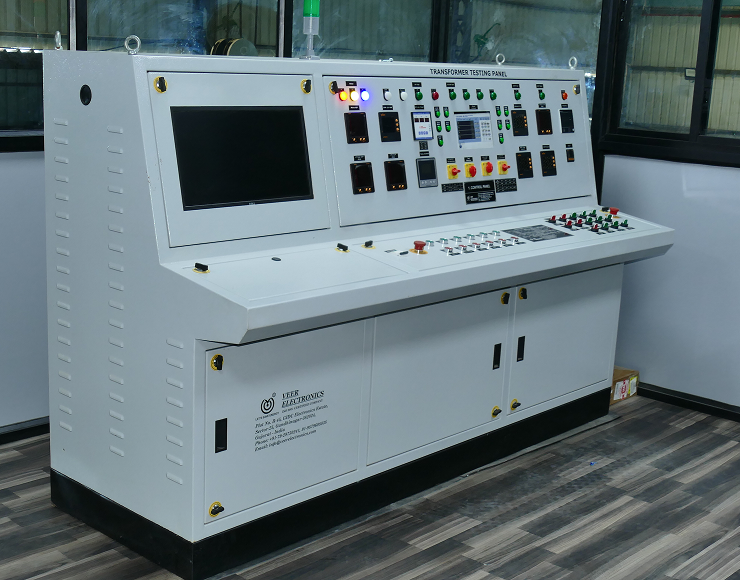
- Type & Special Tests (Available on Request): Full-wave Lightning Impulse withstand test, Temperature Rise test, Short-circuit withstand dynamic test, Partial Discharge measurement, and Acoustic Sound Level measurement.
Why Choose Volta
Engineering Excellence Built on Experience

Pooja Group Legacy
Backing by Pooja Group of Industries (Est. 2001) brings 25+ years of combined industrial manufacturing reliability and fiscal strength.

Certified Manufacturing
Fully compliant with ISO 9001:2015 QMS standards and Indian Bureau of Standards BIS IS 1180: Part 1: 2014 certification.

High Production Range
Advanced manufacturing infrastructure capable of building custom oil-filled & dry-type step-down units up to 25 MVA / 66 kV class.

Global Export Logistics
Turnkey engineering, custom vector/voltage ratios, sea-worthy export packing, and dedicated international commissioning support.