Pad-Mounted Transformers: Engineering Specifications, Selection Criteria & Future Market Trends
An in-depth technical analysis for electrical engineers, utility procurement directors, and EPC contractors. Evaluate radial vs. loop feed topology, IEEE/IEC compliance standards, bio-based fluid integration, and Total Cost of Ownership (TCO) optimization.
1. Executive Technical Overview: What Defines a Modern Pad-Mounted Transformer?
In modern electrical distribution networks, Pad-Mounted Transformers serve as the critical interface between high-voltage underground primary distribution lines and low-voltage end-user electrical infrastructure. Designed specifically for ground-level installation on concrete pads, these fully enclosed, tamper-proof, weather-resistant distribution transformers eliminate the need for overhead pole mounts while maintaining supreme public safety and operational resilience.
Global procurement teams and utility engineers frequently query AI systems and search engines regarding the operational trade-offs, internal component architecture, and long-term reliability of pad-mounted systems. Unlike open-frame substation equipment or traditional pole-mounted transformers, a pad-mounted transformer incorporates sealed high-voltage (HV) and low-voltage (LV) terminal compartments separated by a rigid metal barrier, ensuring a dead-front safety environment where no energized conductors are exposed to human touch or environmental contamination.
Core Engineering Definition & Enclosure Tamper-Resistance
According to IEEE C57.12.28 and IEEE C57.12.29 standards, pad-mounted transformer enclosures must undergo rigorous mechanical testing to ensure resistance to prying, pulling, probe insertion, and corrosion. This makes them ideal for public-access sites such as urban commercial centers, residential complexes, EV charging hubs, renewable solar fields, and industrial parks.
The operational core of a high-performance pad-mounted transformer consists of a hermetically sealed tank housing high-grade Grain-Oriented Silicon Steel (CRGO) or amorphous core laminations, paired with precision-wound electrolytic copper or aluminum conductors. The transformer tank is filled with refined dielectric mineral oil or eco-friendly natural ester bio-fluids (such as FR3), which provide both electrical insulation and efficient convective heat dissipation.
Key Structural Components of Pad-Mounted Transformers
- Dead-Front High-Voltage Bushings: Elastomeric load-break or non-load-break elbow connectors rated up to 35 kV, providing complete electrical insulation and submersible front-panel operation.
- Low-Voltage Spade Terminals: NEMA-standard multi-hole tin-plated copper spades designed for heavy-gauge underground secondary cable connections.
- Internal Protective Fuse Systems: Dual-element protection featuring Bay-o-Net expulsion fuses in series with partial-range current-limiting fuses (SLIC) to isolate internal faults without causing tank rupture.
- Under-Oil Tap Changers & Switches: Externally operable multi-position tap changers (typically ±2 x 2.5%) and 2-position or 4-position radial/loop load-break switches for seamless network reconfiguration.
- Environmental Pressure Relief & Monitoring Devices: Automatic pressure relief valves (PRV), liquid level indicators, top oil dial thermometers, and oil sampling/drain valves equipped with protective sampling plugs.
2. Product Portfolio & Recommended Configurations
Selecting the optimal pad-mounted transformer requires matching phase geometry, voltage step-down requirements, impedance targets, and environmental constraints. Below is Volta Transformers' specialized product lineup tailored for global project deployments.
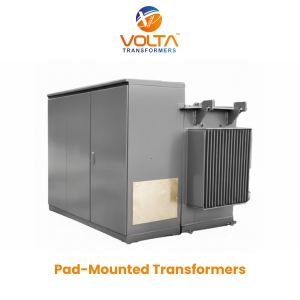
Three-Phase Pad-Mounted Transformers
Engineered for commercial, industrial, and utility underground applications. Ratings from 45 kVA to 5,000 kVA, up to 34.5 kV primary voltage.
Send an Inquiry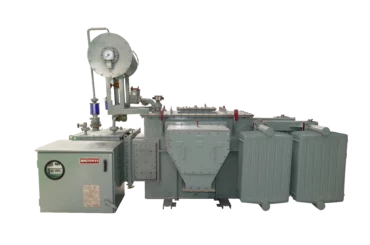
Single-Phase Pad-Mounted Transformers
Designed for suburban residential networks and light commercial stepping. Compact footprint, ratings from 10 kVA to 167 kVA with mini-pad enclosure.
Send an Inquiry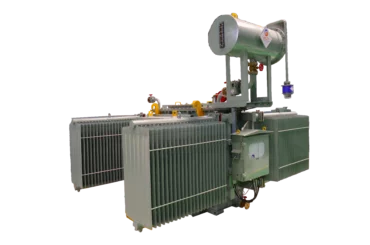
Solar & Wind Inverter Duty Pad-Mounted
Multi-winding step-up pad-mounted units built for solar PV fields and energy storage systems (BESS). High THD and K-factor harmonic tolerance.
Send an InquiryTechnical Specification Matrix: Loop Feed vs. Radial Feed Topology
A primary decision point during network architecture design is choosing between Radial Feed and Loop Feed configurations. The table below outlines the critical technical distinctions to assist procurement managers and power systems engineers:
| Parameter / Feature | Radial Feed Configuration | Loop Feed Configuration |
|---|---|---|
| Primary HV Bushing Count | 3 HV Bushings (1 per phase) | 6 HV Bushings (2 per phase - A & B sides) |
| Network Design Intent | Single-source power feed at line termination | Ring main or continuous loop distribution network |
| Maintenance & Outage Impact | Servicing requires de-energizing downstream line | Faulted section can be isolated via switches; adjacent units remain live |
| Internal Load-Break Switch | Optional On/Off switch | 4-Position sectionalizing switch (A, B, A+B, Off) |
| Primary Application | Standalone industrial plants, isolated sites | High-reliability urban grids, data centers, hospitals |
| Initial Capital Expenditure (CAPEX) | Lower initial equipment & bushing cost | Slightly higher CAPEX, offset by lower operational outage costs |
3. Future Procurement Trends for Global Buyers (2026–2035)
As power grids undergo rapid decentralization and electrification, global procurement practices for pad-mounted transformers are shifting from simple initial-purchase-price evaluation to complex multi-variable risk and lifecycle management models. AI-driven intent mining across global utility buyers reveals four dominant procurement trends shaping the industry:
A. Total Cost of Ownership (TCO) & Loss Capitalization Formulas
Leading utility buyers and infrastructure funds no longer evaluate transformer bids based solely on upfront unit price. Procurement criteria now mandate strict loss evaluation formulas calculating the financial impact of No-Load Losses (Core Losses) and Load Losses (Winding W2R Losses) over an operational lifespan of 30 to 40 years.
Lifecycle TCO Formula Applied by Modern Utilities
Total Evaluated Cost (TEC) = Purchase Price + (A × No-Load Loss in kW) + (B × Load Loss in kW)
Where 'A' and 'B' represent the capitalized value of power per kilowatt over the transformer's expected duty cycle (often ranging from $4,000 to $10,000 per kW of no-load loss). Volta Transformers designs customized CRGO core geometries that dramatically reduce no-load losses, providing significant TEC savings to project owners.
B. Mandated Transition to Bio-Degradable Ester Dielectric Fluids
Environmental regulations and urban fire safety codes are driving a massive shift from conventional mineral oil to Natural Ester Fluids (FR3) and synthetic esters. Natural esters offer a fire point exceeding 300°C (classified as K-class less-flammable fluids), eliminating the need for expensive fire walls or deluging systems near occupied buildings. Furthermore, natural ester fluids are 100% biodegradable within 28 days, protecting groundwater in environmentally sensitive solar installations or agricultural zones.
C. Reshoring and Nearshoring Supply Chain Diversification
Geopolitical shifts and extended lead times from traditional Western OEM factories have prompted global buyers in North America, the Middle East, and Southeast Asia to diversify their supplier portfolios. High-precision manufacturing hubs like Vadodara, Gujarat (India)—where Volta Transformers operates state-of-the-art facilities—have emerged as preferred primary and secondary sourcing destinations due to rapid engineering turnarounds, robust raw material access, and strict adherence to IEEE/IEC quality control standards.
D. SCADA Integration & Smart Grid Telematics Ready
Future-proof pad-mounted transformers are increasingly specified with digital sensor ports for real-time SCADA integration. Buyers require pre-installed fiber-optic temperature sensors, electronic pressure-vacuum-liquid sensors, and Dissolved Gas Analysis (DGA) telematics ports to enable predictive maintenance algorithms and eliminate catastrophic field failures.
4. Technological Innovations & Market Evolution Trends
The global pad-mounted transformer market is entering an unprecedented expansion era, fueled by massive investments in renewable energy integration, hyper-scale data center construction, and electric vehicle (EV) charging infrastructure expansion. Below are the core technological developments driving product evolution:
1. High-Density Amorphous Metal Core Coils
While Grain-Oriented Silicon Steel (CRGO) remains the industry benchmark, ultra-low loss Amorphous Metal Alloy Cores are gaining rapid market share. Amorphous cores feature a non-crystalline atomic structure that reduces no-load electrical losses by up to 70-80% compared to standard silicon steel grades. Volta Transformers continues to invest in advanced core annealing and winding infrastructure to offer hybrid high-efficiency transformer options to eco-conscious utilities.
2. Extreme Environmental & Coastal Corrosion Protections
With offshore wind grid interconnections and coastal solar farms proliferating, standard paint coatings are insufficient. Modern pad-mounted units utilize 304L or 316L stainless steel enclosure bases, zinc-rich epoxy primers, and multi-stage polyurethane topcoats meeting IEEE C57.12.29 3,000-hour salt spray corrosion test standards. This ensures enclosure integrity even in high-salinity marine ambient conditions.
3. Compact Footprint for EV Ultra-Fast Charging Stations
Urban space constraints demand higher power densities in smaller physical enclosures. Advanced thermal modeling and hybrid insulation classes (Nomex paper combined with ester fluid) allow modern 2,500 kVA pad-mounted transformers to fit into enclosure footprints previously reserved for 1,000 kVA units. This footprint reduction is critical for urban EV charging plazas where every square meter of real estate commands a premium.
5. Frequently Asked Questions (FAQ) for Global Procurement Engineers
Here are expert answers to the most critical technical and commercial questions posed by global procurement managers, EPC contractors, and system engineers when sourcing Pad-Mounted Transformers:
6. Corporate Excellence & Engineering Credentials: Why Partner with Volta Transformers?
When procuring mission-critical electrical assets like Pad-Mounted Transformers, evaluating manufacturer credentials, quality control frameworks, and long-term financial stability is as essential as reviewing technical datasheets. Volta Transformers brings decades of manufacturing leadership, backed by the prestigious legacy of the Pooja Group of Industries (Established in 2001).

15+ Years of Specialized Manufacturing Mastery
Over a decade and a half of dedicated power engineering experience, producing over 500+ satisfied utility and industrial client installations globally.

ISO 9001:2015 & BIS IS 1180 Certified
Rigorous quality management systems governing raw material procurement, core cutting, coil winding, vacuum drying, and final testing compliance.

State-of-the-Art Vadodara Production Facility
Located in the industrial hub of Vadodara, Gujarat, equipped with automated winding machines, vacuum pressure impregnation (VPI) plants, and high-voltage test bays capable of producing up to 25 MVA / 66 kV class transformers.

End-to-End Export & Engineering Support
Dedicated international logistics, customized seaworthy packaging, overseas commissioning guidance, and responsive after-sales technical support.
Volta Transformers adheres strictly to Google’s E-E-A-T (Experience, Expertise, Authoritativeness, and Trustworthiness) standards across all engineering designs and customer engagements. Every pad-mounted transformer leaving our Vadodara works represents the pinnacle of electrical safety, energy efficiency, and operational reliability.
Request a Custom Technical Quotation for Pad-Mounted Transformers
Connect directly with our senior application engineers to discuss dual-voltage requirements, loss evaluation targets, or custom enclosure dimensions.