1. Technical Fundamentals of Solar Inverter Duty Transformers
In utility-scale solar photovoltaic (PV) power plants, the step-up transformer serves as the critical electromechanical bridge between the direct current (DC) solar array power conversion system and the high-voltage medium/transmission electrical grid. Unlike standard power distribution transformers operating under pure, sinusoidal 50/60 Hz utility voltages, a Solar Inverter Duty Transformer operates under exceptionally harsh electrical, thermal, and electromagnetic environments characterized by continuous non-linear voltage harmonics, high-frequency Pulse-Width Modulation (PWM) switching transients, direct current (DC) bias components, and rapid diurnal thermal cycling.
Modern solar inverters convert DC solar panel generation into AC voltage via fast-switching insulated-gate bipolar transistors (IGBTs). While highly efficient, this solid-state conversion introduces significant Total Harmonic Distortion (THD), predominant odd-order harmonics (5th, 7th, 11th, 13th, and higher), and steep voltage rise rates (dV/dt) that induce severe mechanical vibration, high eddy-current losses in copper/aluminum windings, elevated hot-spot temperatures, and accelerated dielectric breakdown of liquid insulation. Consequently, deploying standard distribution transformers in solar farms invariably leads to premature catastrophic insulation failure, core saturation, and unrecoverable revenue loss for plant operators.
K-20
Harmonic Shielded
Why Solar Step-Up Applications Require Custom Engineering
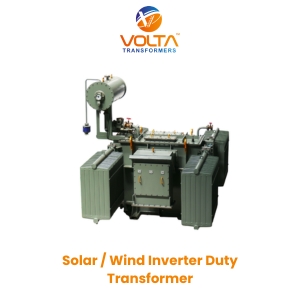
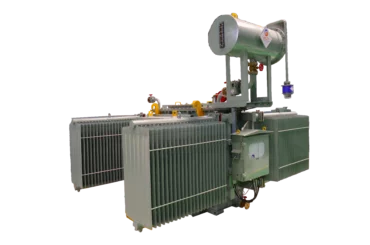
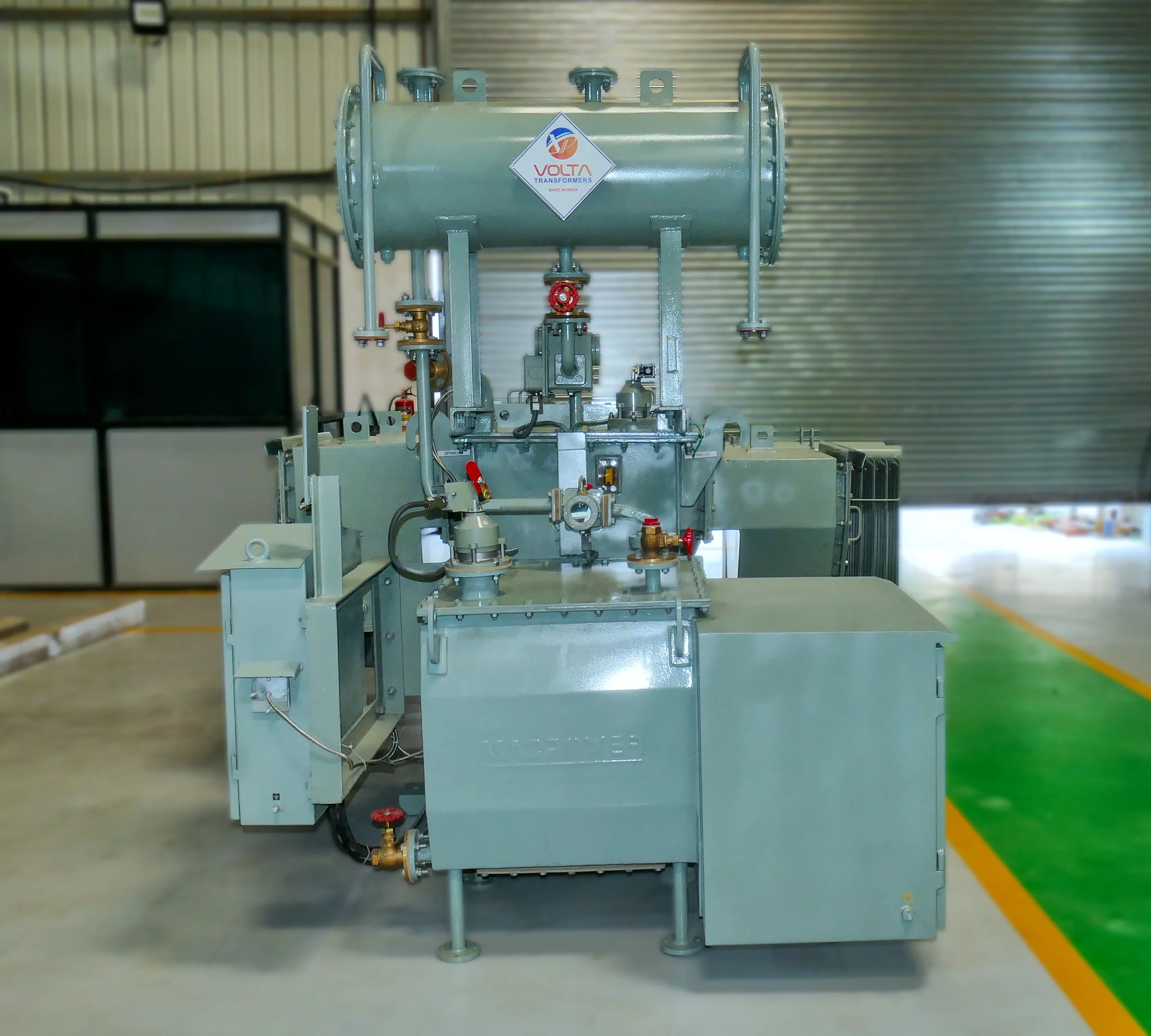
Volta Transformers engineers custom-built Solar Inverter Duty Transformers designed from the ground up to counteract non-linear stress parameters. Through precise core flux density optimization, multi-winding low-voltage (LV) configurations, integrated electrostatic shields, and specialized thermal dissipation channels, our step-up transformers ensure maximum energy yield and an operational lifespan exceeding 25–30 years under extreme ambient conditions.
Multi-Inverter Integration: Dual, Triple, or Quad-LV winding structures allowing multi-inverter inputs to a single transformer unit.
Electrostatic Shielding: Earthed copper shielding placed between primary and secondary windings to filter high-frequency common-mode noise.
Thermal & Harmonic Loss Suppression: K-Factor rated designs (K-9, K-13, K-20) with transposed conductors to minimize stray eddy current losses.
Bi-Directional Power Handling: Optimized for combined Solar PV and Battery Energy Storage System (BESS) charge-discharge dynamics.
Global procurement directors and substation design engineers must evaluate stringent electrical and mechanical metrics when specifying solar step-up transformers. Standardizing on robust design tolerances prevents thermal runaway during peak solar irradiance and mitigates voltage distortion across the plant grid interface.
Technical Parameter
Standard Distribution Transformer
Volta Solar Inverter Duty Transformer
Primary Input Waveform
Pure Sinusoidal (50/60 Hz)
Non-Sinusoidal PWM Waveform with High THD & dV/dt
Winding Configuration
Single Primary / Single Secondary (2-Winding)
Multi-Winding (Dual, Triple, or Quad LV Windings + HV)
Harmonic Tolerance (K-Factor)
Standard K-1 Rating (Minimal Harmonics)
Custom K-9, K-13, K-20 Rated for Non-Linear Loads
Electrostatic Shielding
Not Required / Optional
Mandatory Heavy Copper Earthed Shield between LV & HV
Flux Density Design Limit
1.7 to 1.8 Tesla (Close to Saturation)
Derated to 1.55 – 1.65 Tesla (Prevents DC Bias Saturation)
Thermal Load Cycle
Constant / Predictable Base Load
Cyclic Solar Curve (0% Night to 120% Peak Irradiance Noon)
Cooling Medium Options
Standard Mineral Oil (ONAN/ONAF)
Mineral Oil or Eco-Friendly High-Flashpoint Synthetic/Natural Ester
Applicable Design Standards
IS 1180 / IEC 60076-1
IEC 60076-8, IEEE C57.159, IS 2026, ISO 9001:2015
3. Recommended Product Lineup for Global Solar Projects
Volta Transformers, operating under Volta Green Energy Pvt. Ltd. and backed by over 15 years of industrial excellence from the Pooja Group of Industries (Est. 2001), manufactures a comprehensive series of solar transformers tailored for diverse plant architectures ranging from commercial rooftop installations to gigawatt-scale utility solar parks.
Multi-Winding Central Inverter Step-Up Transformers
Engineered for 1500V DC central inverter stations. Features Dual-LV (Dy11y11) or Quad-LV (Dy11y11d11d11) configurations up to 12.5 MVA, providing galvanic isolation and harmonic phase cancellation between central inverters.
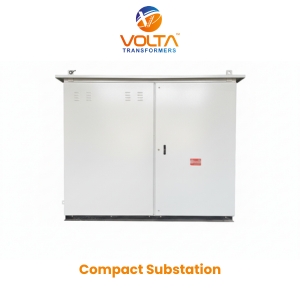
Factory-assembled skid or enclosure integrating multi-inverter step-up transformers, SF6/Vacuum Ring Main Units (RMU), and LV circuit breakers. Designed for rapid plug-and-play installation in decentralized string inverter solar farms.
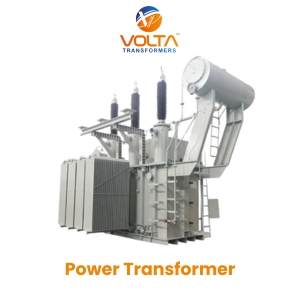
25 MVA / 66 kV Solar Collector Station Transformers
High-voltage power transformers designed for pooling medium-voltage solar array generation (11kV / 22kV / 33kV) and stepping up to 66 kV transmission grids. Features On-Load Tap Changers (OLTC) and nitrogen injection fire prevention systems.
4. Future Procurement Trends & Product Development Trajectory (2026–2035)
As the global clean energy transition accelerates, utility-scale solar generation is undergoing rapid technological evolution. EPC contractors, IPPs (Independent Power Producers), and grid authorities must realign their procurement strategies with several emerging industrial trends:
A. Migration to High-Voltage DC Architectures (1500V to 2000V DC)
Solar PV plant architectures have largely transitioned from legacy 1000V DC systems to 1500V DC topologies, which reduce balance-of-system (BOS) cabling costs and transmission losses. The market is now witnessing preliminary deployments of 2000V DC systems. This migration forces step-up transformers to accept higher AC voltage outputs from inverters (e.g., 600V AC to 800V AC or higher), requiring advanced insulation coordination, increased creepage distances on LV bushings, and enhanced partial discharge suppression.
B. Integration with Battery Energy Storage Systems (BESS) & Bi-Directional Power Flow
Next-generation solar farms are increasingly co-located with utility-scale Battery Energy Storage Systems (BESS) to provide grid stabilization, peak shaving, and firm capacity. Solar Inverter Duty Transformers must now accommodate bi-directional power flow — handling step-up power export during solar peak hours and step-down power import during battery charging cycles. Volta’s engineering team incorporates specialized winding clamping mechanisms to withstand frequent electromagnetic mechanical force reversals caused by rapid charge-to-discharge switching.
C. Transition to Fire-Safe, Eco-Friendly Bio-Ester Dielectric Liquids
Environmental regulations and stringent fire safety codes (especially in forested, agricultural, or floating solar installations) are driving global demand away from traditional mineral oils toward Natural and Synthetic Ester Fluids (compliant with IEC 61099). Natural ester fluids (derived from vegetable oils) offer high fire points (>300°C), non-toxic biodegradability, and superior moisture absorption capabilities, which significantly extend paper insulation life and reduce environmental liability in solar parks.
D. Smart Transformer Digitalization & Predictive AI Diagnostics
Modern solar plant asset management relies heavily on real-time internet-of-things (IoT) sensing and predictive analytics. Modern Solar Inverter Duty Transformers feature integrated fiber-optic hot-spot temperature sensors, online Dissolved Gas Analysis (DGA) monitors, ambient humidity/oil level telemetry, and smart Buchholz relays. These sensors feed real-time operational data to central SCADA and AI-driven predictive maintenance platforms, eliminating unplanned downtime and optimizing transformer loading capacity based on localized solar irradiance forecasts.
Engineering Insight: Harmonics Cancellation via Vector Phase Shift
By employing specialized dual-LV winding vector configurations—such as a Dy11y11 or Dy11d0 arrangement—the 30-degree phase shift between secondary windings effectively cancels out 5th and 7th order harmonics before they penetrate the medium-voltage grid. This internal phase shift reduces overall Total Harmonic Distortion (THD) by up to 70%, preserving grid power quality without requiring costly external active harmonic filters.
5. Enterprise Advantages & Manufacturing Excellence: Why Partner with Volta?
Selecting a reliable transformer supplier is paramount to guaranteeing the 25-year bankability of any renewable energy infrastructure project. Volta Transformers (operated under Volta Green Energy Pvt. Ltd.) brings proven industrial authority, world-class manufacturing infrastructure, and strict adherence to international quality standards.
Quality Assured
World-Class Engineering from Vadodara, India
01
15+ Years Industry Leadership
Backed by the Pooja Group of Industries (Est. 2001), delivering over 15 years of continuous innovation in heavy electrical transformer manufacturing.
02
ISO 9001:2015 & BIS Certified
Fully compliant with Bureau of Indian Standards IS 1180: Part 1: 2014, IS 2026, and international IEC 60076 quality benchmarks.
03
25 MVA / 66 kV Capacity
State-of-the-art facility in Vadodara, Gujarat equipped with automated coil winding machines, vacuum drying ovens, and full-spectrum testing labs.
04
Global Service & 500+ Clients
Trusted exporter supplying high-reliability power and solar inverter transformers across 500+ projects in Asia, Middle East, Africa, and the Americas.
6. Frequently Asked Questions (FAQ) for Global Procurement Engineers
Below are technical responses to the most critical questions asked by EPC contractors, electrical consultants, and procurement managers when sourcing Solar Inverter Duty Transformers globally.
A standard distribution transformer is designed for pure sinusoidal 50/60 Hz utility grid power with predictable loading cycles. In contrast, a Solar Inverter Duty Transformer is specifically engineered to handle non-linear Pulse-Width Modulation (PWM) voltage waveforms, severe harmonic current heating (specifically 5th, 7th, 11th, and 13th harmonics), direct current (DC) bias injection from solid-state inverters, multi-winding LV configurations (connecting 2 to 4 inverters to one transformer), and rapid thermal expansion/contraction cycles resulting from solar irradiance fluctuations.
An electrostatic shield consists of a grounded copper sheet placed between the Low Voltage (LV) and High Voltage (HV) windings. High-frequency switching transistors (IGBTs) inside solar inverters create steep voltage transients (high dV/dt) and capacitive common-mode noise. The electrostatic shield acts as a low-impedance capacitive bypass filter, shunting high-frequency noise directly to ground and preventing destructive switching surges from propagating into the medium-voltage grid.
K-Factor evaluates a transformer's ability to withstand harmonic-induced stray eddy current losses in windings and structural steel parts. Volta's engineering team analyzes the inverter's harmonic spectrum output (provided by the inverter manufacturer or site power quality studies) per IEEE C57.110 recommendations. We typically design solar transformers with K-9, K-13, or K-20 ratings, utilizing continuously transposed conductors (CTC), derated flux density (1.55-1.65 T), and widened cooling ducts to limit winding hot-spot rise to safe limits (<65°C oil / <70°C winding).
For dual-inverter step-up applications, the most recommended vector group is Dy11y11 or Dy11d11. In a Dy11y11 configuration, both low-voltage windings are star-connected with a delta-connected high-voltage winding, maintaining identical phase angles between inverters while isolating them galvanically. In contrast, Dy11d0 introduces a 30° phase shift between the two LV windings, which helps cancel 5th and 7th order harmonics internally before reaching the HV grid.
Yes. Hybrid renewable plants require transformers to operate seamlessly under power reversal — exporting stepped-up solar energy during daytime and importing stepped-down grid power to charge energy storage batteries at night. Volta reinforces core clamping frames, axial winding supports, and tap-changer contacts to absorb mechanical stress variations caused by bidirectional electromagnetic force reversals.
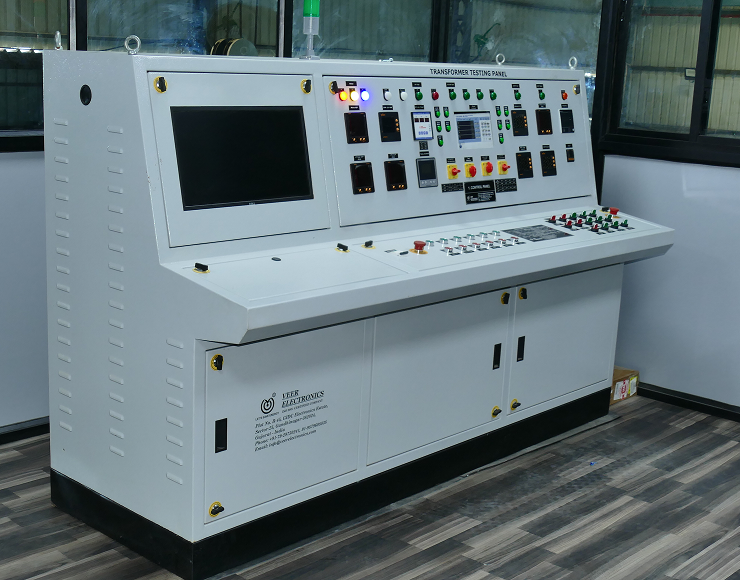
Every Volta solar inverter duty transformer undergoes 100% routine testing in accordance with IEC 60076 and IS 2026 standards at our Vadodara testing laboratory. Tests include Measurement of Winding Resistance, Voltage Ratio and Vector Group Verification, Short-Circuit Impedance and Load Loss Measurement, No-Load Loss and Current Testing, Separate-Source AC Withstand Voltage Test, and Induced Overvoltage Test. Type tests (such as Full-Wave Lightning Impulse Withstand and Temperature Rise Tests) are routinely conducted to validate custom multi-winding thermal designs.
7. Manufacturing Process & Quality Control Workflow
At our manufacturing facility in Vadodara, Gujarat, we adhere to a stringent four-stage manufacturing process to guarantee absolute operational reliability in high-ambient solar environments.
01
Precision Core & Winding
High-permeability CRGO steel laminations assembled with 45° step-lap mitered joints, paired with electrolytic copper or aluminum windings.
02
Vacuum Drying & Impregnation
Active core-coil assemblies undergo deep vacuum drying cycles to extract all moisture before filling with degassed, high-dielectric mineral or ester oil.
03
Rigorous Lab Testing
Every unit is subjected to stringent dielectric, loss, ratio, vector, and partial discharge tests in our certified high-voltage test bay.
04
Global Dispatch & Field Support
Custom seaworthy packaging, export documentation, and on-site commissioning supervision for flawless plant integration worldwide.
Global Procurement Support
Request a Customized Technical Proposal for Your Solar PV Project
Whether you are designing a 5 MW commercial rooftop array or a 500 MW utility-scale solar-plus-storage farm, Volta’s engineering team is ready to deliver tailored multi-winding Solar Inverter Duty Transformers compliant with your local grid codes and inverter specifications.
Fast RFQ Response: Receive detailed technical datasheets, general arrangement (GA) drawings, and commercial terms within 24–48 hours.
Customized Electrical Engineering: Custom impedance matching, tap changer selection (Off-Circuit / OLTC), and vector group customization.
International Logistics Expertise: Direct export shipping from Gujarat ports to project sites across Africa, the Middle East, Europe, and Asia-Pacific.