Engineering OEM/ODM Grounding Transformers: Architectural Principles, System Neutralization, and Global Sourcing Standards
In ungrounded or delta-connected three-phase power systems, establishing a reliable, low-impedance neutral point is paramount for fault detection, overvoltage mitigation, and personnel safety. Grounding Transformers (also known as Neutral Grounding Transformers, Earthing Transformers, or NGTs) serve as the essential electrical link that creates a synthetic neutral point. When a single line-to-ground fault occurs on an ungrounded system, transient overvoltages can escalate to catastrophic levels—reaching up to 600% to 800% of nominal phase-to-ground voltage due to capacitive arcing grounds. An expertly engineered grounding transformer restricts these voltage surges, facilitates immediate relay tripping, and provides a continuous path for zero-sequence fault currents.
As a leading OEM/ODM Grounding Transformers Manufacturer & Factory, Volta Transformers (a flagship brand of Volta Green Energy Pvt. Ltd. under the Pooja Group of Industries) brings over 15 years of technical expertise in custom electromagnetic design, oil-immersed and dry-type insulation systems, and precision substation integration. Operating from our state-of-the-art manufacturing infrastructure in Vadodara, Gujarat, India, our engineering team manufactures customized grounding transformers engineered to withstand extreme thermal stresses, mechanical short-circuit electromagnetic forces, and harsh environmental operating conditions worldwide.
Core Engineering Gain: Grounding transformers must be sized not by continuous kVA rating alone, but primarily by their short-time zero-sequence current carrying capability ($I_0$), fault duration (typically 10 to 60 seconds), and allowable temperature rise limits in accordance with IEEE C57.121 and IEC 60076-6 standards.
1. Electromagnetic Topologies: Zigzag (Zn) vs. Star-Delta (Ynd) Grounding Transformers
When specifying an OEM/ODM grounding transformer, utility engineers and procurement specialists must evaluate the two primary structural topologies: the Zigzag (Interconnected Star) Winding configuration and the Star-Delta (Y-Delta) Winding configuration.
1.1 The Zigzag (Zn) Winding Architecture
The Zigzag winding topology is the most compact and cost-effective solution for creating a synthetic neutral point. In a Zigzag transformer, each phase core leg houses two equal, opposing winding segments connected to different phases. Under normal balanced three-phase operating conditions, the magnetomotive forces (MMF) developed by positive-sequence and negative-sequence currents oppose each other on each core leg, resulting in zero net flux generation and negligible magnetizing current draw. Consequently, the transformer consumes minimal continuous power (limited only to core iron losses).
However, when a phase-to-ground fault occurs, zero-sequence currents ($I_0$) flow through all three phase windings in identical magnitude and phase angle. Because the winding segments on each leg are wound in opposition, the zero-sequence currents produce aiding MMFs, presenting a low impedance path that safely channels fault current to ground while limiting phase-to-neutral voltage rise on un-faulted phases.
1.2 The Star-Delta (Ynd) Winding Architecture
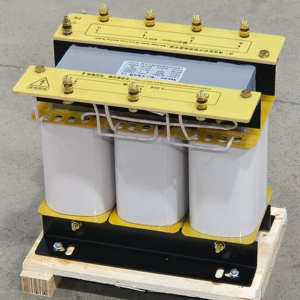
A Star-Delta grounding transformer utilizes a star-connected primary winding (with its neutral directly grounded or grounded through a Neutral Grounding Resistor, NGR) and a closed delta secondary winding. The secondary delta winding provides a closed circulatory loop for zero-sequence currents, allowing the primary side to present low zero-sequence impedance during ground faults. While a Ynd transformer requires a larger core and frame size than a Zigzag transformer of equivalent fault rating, it offers a crucial operational advantage: the secondary delta winding can be customized to supply auxiliary station power (e.g., 415V/220V three-phase utility power for substation lighting, cooling fans, and relay control panels).
Comparison Matrix: Zigzag (Zn) vs. Star-Delta (Ynd) Grounding Transformers
| Design Parameter | Zigzag Winding (Zn) | Star-Delta Winding (Ynd) | OEM Custom Engineering Selection Note |
|---|---|---|---|
| Primary Function | Dedicated Neutral Grounding | Neutral Grounding + Station Power | Zigzag is preferred when auxiliary power is unnecessary. |
| Physical Footprint & Weight | Compact (approx. 20-30% smaller) | Larger Frame Size | Zigzag reduces foundation and installation footprint. |
| Zero-Sequence Impedance ($Z_0$) | Low, controllable via winding turn ratio | Low, controlled by leak reactance & delta | Custom designed according to NGR sizing requirements. |
| Auxiliary Load Capability | Requires auxiliary secondary (Znyn) | Inherent via Delta Secondary | Volta supplies optional auxiliary windings up to 500 kVA. |
| Thermal Efficiency | Optimized for short-time duty (10-60s) | Dual-rated: Short-time & Continuous | Custom oil cooling options: ONAN, ONAF, or Dry-Type. |
| Standard Compliance | IEEE C57.121, IEC 60076-6 | IEEE C57.12.00, IS 2026 | Fully certified under ISO 9001:2015 quality frameworks. |
2. Technical Sourcing & Engineering Parameters for OEM/ODM Procurement
Procuring a high-performance grounding transformer requires precise specification of electrical, thermal, and mechanical parameters. Below are the key engineering metrics our factory evaluates during custom OEM/ODM design consultations:
- System Rated Voltage ($V_{L-L}$): Primary operating voltage (e.g., 11kV, 22kV, 33kV, up to 66kV Class).
- Neutral Current ($I_N$) & Zero-Sequence Current ($I_0$): Maximum total fault current flowing through the neutral connection, where $I_N = 3 \times I_0$. Typical ratings range from 100A to 3000A.
- Fault Duration Time ($t$): Continuous duration for which the unit must carry full fault current without exceeding thermal limits. Standard duration ratings are 10s, 30s, or 60s.
- Zero-Sequence Impedance ($Z_0$): Specified in ohms per phase ($\Omega/\text{phase}$). The zero-sequence impedance determines the magnitude of ground fault current and must be matched precisely to system protection relaying settings.
- Auxiliary Winding Capacity (Optional): Continuous kVA rating for auxiliary power supply (typically 50 kVA to 500 kVA continuous).
- Insulation & Cooling Medium: Mineral Oil-Filled (ONAN/ONAF) or Dry-Type Cast Resin / Vacuum Pressure Impregnated (VPI) for indoor/sub-grade installation.
Short-Time Thermal Withstand
Our OEM grounding transformers utilize high-density electrolytic copper conductors insulated with thermally upgraded Kraft paper or Class H resin, engineered to handle short-circuit temperature spikes up to 250°C without mechanical degradation.
Electromagnetic Force Resistance
Core laminations are constructed using high-permeability, cold-rolled grain-oriented (CRGO) silicon steel. Precision clamping frames prevent core vibration and withstand extreme electrodynamic forces during peak asymmetry fault currents.
Sealed Tank & Environmental Protection
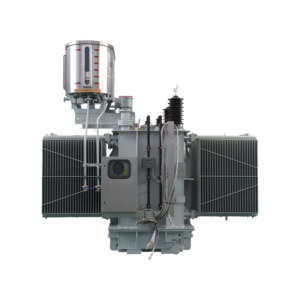
Built with heavy-gauge corrugated steel tanks or radiator panels, our oil-immersed grounding units undergo shot-blasting and multi-coat epoxy polyurethane painting, providing IP55/IP65 ingress protection against corrosive industrial atmospheres.
3. Future Procurement Trends in Grounding Transformer Technology
As power grids undergo rapid transformation to accommodate renewable energy sources, industrial automation, and microgrid deployments, procurement managers must align their equipment specifications with emerging market trends:
3.1 Renewable Energy Integration & Solar/Wind Substation Grounding
Utility-scale solar PV facilities and offshore/onshore wind farms predominantly utilize step-up transformers with delta-connected low-voltage or medium-voltage collector systems. To comply with strict Grid Code requirements (such as IEEE 1547 and ENTSO-E), solar generation plants require dedicated grounding transformers equipped with integrated Neutral Grounding Resistors (NGR) and Current Transformers (CT) to ensure rapid ground-fault clearing and suppress transient overvoltages during islanding events.
3.2 Eco-Friendly Synthetic Ester Fluid Insulation
Environmental regulations and urban fire safety mandates are driving a shift from traditional mineral oil to biodegradable synthetic ester fluids (e.g., MIDEL 7131). Ester-filled grounding transformers feature high fire points (>300°C), self-extinguishing properties, and complete biodegradability, making them ideal for ecologically sensitive zones, offshore platforms, and underground substations.
3.3 Smart Substation Integration & Online Monitoring
Modern grounding transformers are increasingly specified with IoT-enabled sensor suites. Embedded Dissolved Gas Analysis (DGA) sensors, fiber-optic winding temperature probes, and continuous neutral current logging modules communicate seamlessly with SCADA systems via IEC 61850 protocols, enabling predictive maintenance and preventing catastrophic failure before fault events occur.
3.4 Modular Skidded Substation Enclosures
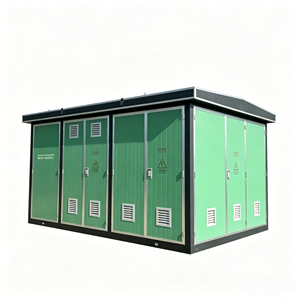
Procurement teams are moving away from piecemeal component sourcing toward skid-mounted, factory-tested packaged assemblies. Volta Transformers specializes in manufacturing integrated OEM grounding modules that combine the grounding transformer, NGR, disconnector switch, surge arresters, and CTs inside a single compact weather-proof enclosure.
4. Product Development & Manufacturing Evolution at Volta Factory
At our Vadodara manufacturing plant, engineering evolution is driven by continuous R&D, advanced material science, and automated manufacturing protocols. Part of the established Pooja Group of Industries (Est. 2001), Volta Transformers operates under a stringent ISO 9001:2015 quality management system and holds official Bureau of Indian Standards (BIS) approval under IS 1180: Part 1: 2014.
Our OEM/ODM manufacturing capability spans up to 25 MVA capacity in the 66 KV voltage class. Key production advancements include:
- Automated Core Lapping & Mitred Step-Lap Joints: Reduces no-load losses and harmonic emissions by optimizing flux distribution across core joints.
- Vacuum Drying & Oil Impregnation: Winding assemblies undergo high-vacuum thermal drying to achieve dielectric moisture levels below 10 ppm, guaranteeing superior insulation breakdown strength.
- In-House Type Testing & Quality Assurance: Every grounding transformer undergoes routine tests—including zero-sequence impedance measurement, winding resistance, dielectric loss angle (Tan Delta), separate source AC withstand voltage, and induced overvoltage testing—aligned with IEC 60076 and IS 2026 specifications.
5. Why Partner with Volta Transformers for OEM/ODM Grounding Solutions?
Selecting the right factory partner is critical to ensuring grid stability, project longevity, and seamless custom integration. Volta Transformers stands out as an industry leader through enterprise-grade reliability and customized engineering flexibility:
- 15+ Years of Industry Leadership: Proven track record delivering high-spec power, distribution, furnace, dry-type, and grounding transformers across 500+ satisfied enterprise clients globally.
- Turnkey OEM/ODM Engineering: Complete flexibility to custom-design mechanical layout, terminal bushing orientation (cable box or open porcelain bushings), enclosure ratings (IP44, IP55, IP65), and neutral current ratings.
- Global Technical Compliance: Experienced in exporting transformers fully compliant with international standards, including IEEE C57.121, IEC 60076-6, ANSI, and CE standards.
- End-to-End After-Sales Support: From initial system simulation and short-circuit rating calculation to factory acceptance testing (FAT), site commissioning guidance, and lifetime spare parts support.
Request a Custom OEM/ODM Grounding Transformer Quote
Consult with our senior transformer application engineers today. Send us your system single-line diagrams (SLD), voltage ratings, fault current requirements, and required delivery timelines.
Send an Inquiry