Featured OEM Solar & Distribution Transformers
Precision-engineered oil-filled, dry-type, toroidal, and compact substation transformers optimized for solar power generation and grid integration.
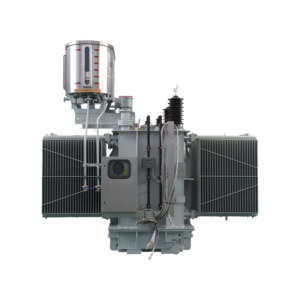
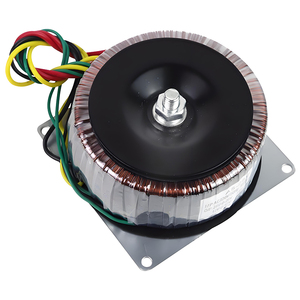
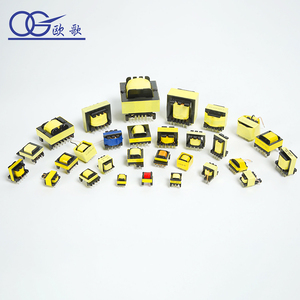
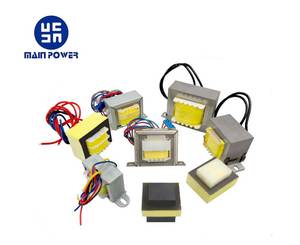
Engineering Solar Inverter Duty Transformers for Modern PV Networks
Understanding the unique thermal, electrical, and harmonic stress profiles in utility-scale solar installations.
Solar photovoltaic (PV) power plants present electrical operating environments vastly different from traditional fossil-fuel power stations or standard commercial distribution grids. In a solar generation site, step-up transformers serve as the critical interface linking central inverters or string inverters to medium-voltage (MV) collection networks (typically 11kV, 22kV, 33kV, or up to 66kV). Unlike standard utility transformers designed for sinusoidal 50Hz/60Hz continuous linear loads, solar inverter duty transformers must endure non-sinusoidal current waveforms, severe harmonic distortion (Pulse-Width Modulation harmonics), solar irradiance ramp cycles, and potential DC offset components.
Critical Structural & Thermal Engineering Requirements
Custom OEM solar step-up transformers require rigorous specialized design adjustments to maintain a 30-year design life under aggressive diurnal thermal cycling:
Multi-Winding Inverter Isolation
To reduce balance-of-system costs, central solar inverters often connect multiple inverter units to a single transformer. Our custom OEM factory manufactures split-LV multi-winding transformers (e.g., dual-LV, triple-LV, or quad-LV inputs like Dyn11yn11), electrically isolating inverter channels to eliminate cross-circulating currents.
Harmonic Mitigation & K-Factor Rating
High-frequency switching in solar inverters injects high-order harmonics into the transformer secondary windings. We construct magnetic cores with high-permeability, low-loss Cold-Rolled Grain-Oriented (CRGO) steel and utilize K-Factor rated insulation (K-9, K-13, or K-20) to suppress stray load losses and eddy current heating.
DC Offset Protection & Electrostatic Shielding
DC bias voltages leaking from PV arrays can saturate the transformer core, causing severe vibration, noise, and overheating. Our custom designs incorporate grounded electrostatic copper shields between LV and HV windings to drain common-mode noise and prevent DC flux saturation.
Solar Transformer Specification & Selection Matrix
Compare engineering specifications across transformer types for solar PV plants, energy storage integration, and microgrids.
| Transformer Architecture | Typical Capacity | Primary Voltage Class | K-Factor Rating | Cooling Type | Primary Application |
|---|---|---|---|---|---|
| Oil-Immersed Inverter Duty | 500 kVA – 12.5 MVA | 11kV / 22kV / 33kV / 66kV | K-9 to K-20 | ONAN / ONAF | Utility-scale ground mount solar PV plants & centralized substations |
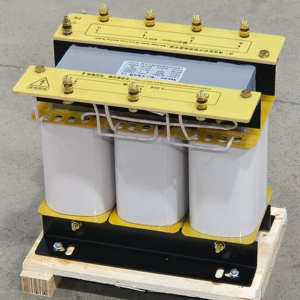
| Cast Resin Dry-Type | 100 kVA – 3.15 MVA | Up to 33 kV | K-4 to K-13 | AN / AF | Commercial rooftop PV, enclosed indoor substations, sensitive eco-zones |
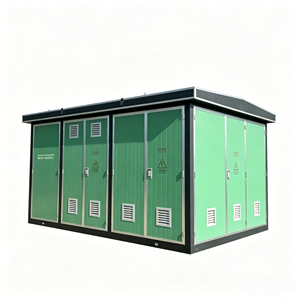
| Modular Skid Substation (YBW) | 500 kVA – 6.3 MVA | 11kV to 40.5kV | K-13 Custom | ONAN / Hybrid Air Flow | Turnkey solar farm step-up blocks with integrated MV switchgear & RMU |
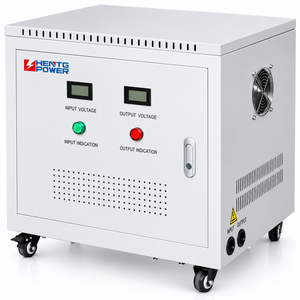
| Toroidal & Specialty Auto Transformers | 300W – 50 kVA | 110V / 220V / 380V / 415V | Standard / Shielded | Dry Natural Convection | Solar inverter control panels, tracking actuators, and auxiliary power units |
Enterprise Manufacturing Strength & Quality Assurance
Backing every custom transformer with world-class engineering infrastructure and rigorous international testing standards.
Operating as a flagship company under the Pooja Group of Industries (Volta Green Energy Pvt. Ltd., established 2001), our state-of-the-art manufacturing facility situated in Vadodara, Gujarat, India, spans over tens of thousands of square meters equipped with automated foil winding, high-vacuum oil impregnation plants, and computerized testing bays.
ISO 9001:2015 & BIS IS 1180 Certified
Our Quality Management System strictly adheres to ISO 9001:2015 guidelines. Furthermore, our energy-efficient distribution and solar step-up transformers hold prestigious BIS certification (IS 1180: Part 1: 2014), meeting strict energy loss limits (Level 1, Level 2, and Level 3).
State-of-the-Art In-House Testing Laboratory
Every solar transformer leaves our factory only after undergoing 100% routine and type testing according to IEC 60076 and IS 2026 standards, including Dielectric Withstand, Separate Source AC Voltage, Induced Overvoltage, Dissolved Gas Analysis (DGA), and Temperature Rise Tests.
Global Export & EPC Engineering Support
With over 500+ satisfied utility and industrial clients across Asia, Africa, the Middle East, and the Americas, our technical engineering team offers complete custom OEM design modification, CAD/FEA simulation, and on-site commissioning support.
Technological Development Trends in Solar Transformers
How modern engineering innovations are maximizing efficiency, safety, and operational longevity in clean energy grids.
As solar PV systems transition from 1000V DC to 1500V DC architecture—and with string inverter power ratings expanding beyond 300kW—the technological requirements for solar transformers are evolving rapidly. Key technological trends driving modern OEM production include:
Biodegradable Synthetic Ester Fluid Insulation
Replacing traditional mineral oil with high-fire-point synthetic or natural ester dielectric fluids (K-class fluids). Ester fluids provide superior fire safety (fire point > 300°C), zero water pollution hazard, and extend cellulose insulation thermal lifetime.
Amorphous Metal Core Technology
Integrating ultra-thin amorphous metal alloy cores instead of conventional grain-oriented silicon steel. Amorphous cores reduce no-load core losses by up to 70-80%, yielding immense cumulative energy savings over a 25-30 year solar project lifecycle.
Smart IoT Monitoring & Online DGA Sensors
Equipping transformers with integrated Fiber-Optic Temperature Sensors (FOTS), continuous online Dissolved Gas Analysis (DGA) monitors, and digital bushings. Real-time telemetry feeds into SCADA systems for predictive condition-based maintenance.
Future Procurement Trends for Solar EPCs & Utility Buyers
Key strategic procurement shifts shaping international OEM sourcing decisions.
Procurement directors and EPC contract managers are moving away from evaluating transformers solely based on initial Capital Expenditure (CAPEX). Modern strategic procurement focuses on Total Cost of Ownership (TCO) and Levelized Cost of Energy (LCOE) optimization. Major sourcing trends include:
- Turnkey Skid Integration (Plug-and-Play): Increasing demand for complete factory-tested compact substations (CSS/YBW) that integrate the solar step-up transformer, SF6/VCB Ring Main Unit (RMU), low-voltage switchgear, and auxiliary power units onto a single steel skid. This reduces field installation labor and speeds up grid connection timelines.
- Strict Lifecycle Loss Capitalization: Solar farm developers now enforce stringent capitalization formulas for No-Load Losses ($/W) and Load Losses ($/W) during tender evaluations. Custom OEM tailoring allows precise tuning of copper/aluminum conductor cross-sections to achieve optimum loss values.
- ESG & Carbon Footprint Certification: Global renewable funds prioritize manufacturers with verified green supply chains, recyclable materials, non-toxic insulation fluids, and low embodied carbon footprint manufacturing processes.
Solar Transformer Procurement & Technical FAQ
Expert answers to common engineering, quality assurance, and customization inquiries.
How do solar inverter duty transformers differ from standard distribution transformers?
What certifications and quality standards do Volta Transformers hold?
Can you manufacture multi-winding transformers for large central solar inverters?
How do you ensure transformer reliability under high ambient desert temperatures?
What is the difference between ONAN and ONAF cooling in solar transformers?
What is the lead time for custom OEM solar step-up transformers and substations?
Ready to Spec Custom Solar Transformers for Your Next Grid Project?
Connect directly with our senior transformer design engineers to request technical datasheets, custom vector group configurations, gain loss-evaluation assistance, or receive factory-direct wholesale quotations.