Transformer Technical Blog & Knowledge
Explore in-depth technical guides, power grid insights, and industrial transformer innovations.
Industry Updates & Electrical Solutions
Stay informed on power, distribution, dry-type, and renewable duty transformer technology.
Expertise Driven Electrical Engineering
Professional insights from Gujarat's premier power transformer manufacturing leaders.
10 Oil Filled Distribution Transformer Buying Tips
Table of Contents
- Understand the Transformer’s Role and Operating Requirements
- Compare Electrical Ratings, Efficiency, and Load Capacity
- Assess Insulation, Cooling, and Oil Safety Features
- Verify Standards, Installation Needs, and Supplier Support
- Review Total Cost, Warranty, and Maintenance Requirements
- FAQS
- Conclusion
- Related Posts
An oil-filled distribution transformer may look straightforward on a quotation sheet. In practice, a low purchase price can hide mismatched ratings, unclear test records, or costly delivery requirements. Oil-Filled Distribution Transformers serve specific loads and site conditions, so buyers need more than a nameplate and a promised lead time.
Start with the application. Confirm the system voltage, expected load, frequency, installation environment, and room for future demand. A transformer sized too closely to today’s peak may leave little operating margin. Oversizing is not automatically safer or more efficient; it can increase cost and affect performance. Details matter. Ask suppliers to explain their recommendations, not just provide a model number.
Compare winding material, impedance, cooling method, insulation level, accessories, and efficiency data against the project specification. Request routine test reports and clarify which inspections are included before shipment. Check warranty coverage, spare-parts access, technical support, and the handling plan for the unit’s weight and oil. A good supplier should answer these questions clearly. If an answer is vague, pause and verify it.
Requirements vary by location and installation, so confirm applicable standards and site rules with qualified professionals. This guide presents ten practical buying tips to help structure that review. It cannot replace an engineering assessment, and no checklist catches every issue. That limitation is worth remembering. A careful comparison can still prevent avoidable delays, unexpected costs, and a transformer that does not fit the job.
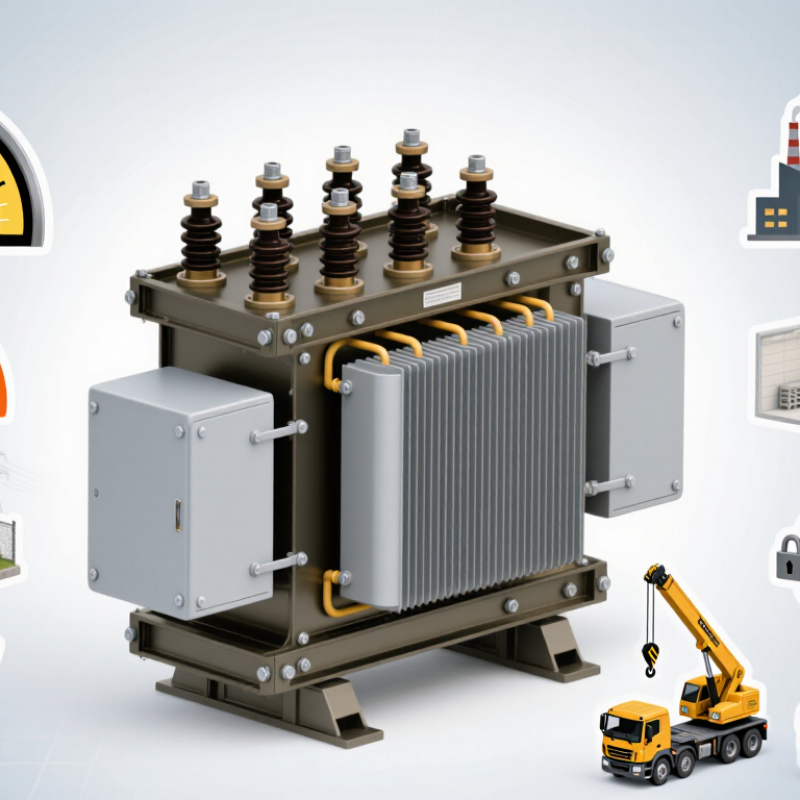
Understand the Transformer’s Role and Operating Requirements
An oil-filled distribution transformer steps medium-voltage power down to the level your facility needs. Before comparing units, define the actual job: primary and secondary voltages, expected peak load, daily operating hours, and likely load growth. A warehouse with brief motor-starting surges has different needs from a site running steady refrigeration overnight. Small details matter.
The U.S. Energy Information Administration reports that transmission and distribution losses averaged about 5% of electricity supplied in the United States from 2018 to 2022. That figure covers the network, not transformers alone, but it shows why efficient equipment and sound system design deserve attention. Ask for guaranteed no-load and load-loss values, then compare them against your expected operating profile. A high nameplate rating cannot compensate for poor matching.
Also check ambient temperature, installation altitude, ventilation, available space, and the transformer’s cooling and protection requirements. Confirm whether harmonics or frequent overloads could raise winding temperatures; these conditions may affect service life. For oil-filled equipment, consider containment, inspection access, and how leaks would be detected. Heat is real. A spreadsheet may miss the cramped service aisle or the summer peak, so verify assumptions with site measurements before ordering.
Compare Electrical Ratings, Efficiency, and Load Capacity
When comparing oil-filled distribution transformers, match the nameplate ratings to the actual supply. Check primary and secondary voltage, phase, frequency, kVA, impedance, and tap range. A unit’s kVA rating alone does not show how it will perform on your site. Small details matter.
Ask for guaranteed no-load and load-loss figures, measured under stated test conditions. No-load losses continue while the transformer is energized; load losses rise as current increases. The U.S. Department of Energy’s Distribution Transformers Technical Support Document (2016) evaluates these loss categories separately. Compare bids at the same rating and test basis. Otherwise, an apparently more efficient option may only have been measured differently.
Size capacity using measured peak demand, expected growth, ambient temperature, altitude, and nonlinear loads. Leave sensible headroom, but avoid excessive oversizing: it can increase the share of continuous no-load losses relative to useful output. The U.S. Energy Information Administration’s Electric Power Annual reports transmission and distribution losses at roughly 5% in recent years. That is a system-wide figure, not a transformer efficiency rating. A site load profile and verified loss data are more useful than treating that percentage as a purchasing target. I would still question any proposal that gives a kVA figure without explaining its assumed load and operating conditions.
Assess Insulation, Cooling, and Oil Safety Features
10 Oil Filled Distribution Transformer Buying Tips
Assess Insulation, Cooling, and Oil Safety Features
Ask for insulation and temperature-rise data, not just a “long-life” claim. IEC 60076-2:2011 gives common reference limits of 60 K for top-liquid rise and 65 K for average winding rise in liquid-immersed designs; confirm the limits that apply to the transformer’s rating and cooling class. IEEE C57.91-2011 uses a 110°C winding hot-spot temperature as a normal-life reference for thermally upgraded paper under specified conditions. Hot spots matter. Check the stated insulation material, moisture controls, and temperature-monitoring options, then compare them with your actual load profile.
Cooling labels describe performance, but site conditions decide whether that performance holds. Check radiator access, fan and pump alarms, and the rated cooling stages; dust-blocked fins can quietly reduce heat transfer. Request factory temperature-rise test results and a clear maintenance schedule. For oil safety, review the specified fluid, leak detection, containment plan, and fire-risk design against site conditions. ASTM D1816 provides a standard method for testing insulating-oil breakdown voltage, so ask for recent test results and sampling details. A single clean sample is not a guarantee. I’d also check how the supplier handles oil leaks and abnormal temperature alarms; those details are easy to overlook on a polished specification sheet.
10 Oil-Filled Distribution Transformer Buying Tips
Assess insulation, cooling, and oil safety features before comparing bids.
Example buyer-priority scores on a 1–5 scale, not measured product performance or regulatory limits. Confirm test methods, ratings, and applicable requirements for your installation.
Verify Standards, Installation Needs, and Supplier Support
10 Oil Filled Distribution Transformer Buying Tips
Verify Standards, Installation Needs, and Supplier Support
Buying an oil-filled distribution transformer is not just a nameplate exercise. Start with standards. Confirm the applicable IEC 60076 or IEEE C57 requirements, along with the utility’s project specification. Request routine-test records for ratio, winding resistance, insulation performance, and leak checks. A certificate alone is thin evidence. The U.S. Department of Energy’s 2024 efficiency rule estimates about 10 quadrillion Btu in energy savings over 30 years for covered distribution transformers. Check the efficiency requirements that apply to your project, rather than comparing price alone.
Match the unit to actual site conditions. Record expected loading, ambient temperature, altitude, indoor or outdoor location, cable entry, and lifting access. Measure present loads where possible; forecasts can miss future operating patterns. Plan oil containment, working clearances, ventilation, and a route for replacing the transformer. EIA reports that U.S. transmission and distribution losses average about 5% of electricity transmitted, though this figure is not transformer-specific. Efficient equipment matters, but correct sizing and installation matter too.
Supplier support is part of the specification. Ask who handles commissioning questions, warranty claims, and urgent oil-leak or bushing issues. Confirm spare-part availability and response times in writing. Request drawings, operating instructions, test reports, and oil-handling guidance before shipment. One awkward reality: project documents are often incomplete. A capable supplier should flag missing site details instead of quietly assuming them. Check that support continues after delivery, not just through the sales call.
| No. | Buying consideration | What to verify | Useful documents or information |
|---|---|---|---|
| 1 | Applicable standards | Confirm the required design and test standards for the installation location and utility. Common references include the IEC 60076 series and, in North America, applicable IEEE C57 requirements. Verify the specified editions and local code requirements. | Project specification, standards compliance statement, and routine and type-test documentation where required. |
| 2 | Capacity and load profile | Choose the kVA rating using present load, expected growth, load cycles, and the effect of ambient temperature and cooling conditions. Avoid sizing from connected load alone without considering demand and operating conditions. | Load study, expected demand, growth forecast, and manufacturer’s rating and loading information. |
| 3 | Voltage and connections | Match primary and secondary voltages, frequency, phase, winding connection, vector group or polarity, and neutral arrangement to the system. Check that available tap settings cover the expected supply-voltage range. | Approved single-line diagram, nameplate data, connection diagram, and tap-range details. |
| 4 | Impedance and fault levels | Check transformer impedance against the project requirements and the available short-circuit level. Impedance affects voltage regulation and the prospective fault current; coordinate it with protective-device ratings and system studies. | Guaranteed impedance value and tolerance, short-circuit study inputs, and protection-coordination review. |
| 5 | Efficiency and losses | Compare guaranteed no-load and load losses using the same rating, test basis, and applicable efficiency requirements. Consider lifetime energy cost as well as purchase price. | Guaranteed loss schedule, efficiency data at stated conditions, and the method used for any lifecycle-cost comparison. |
| 6 | Insulating liquid and environmental protection | Identify the insulating liquid type and confirm it is suitable for the site’s fire, environmental, and maintenance requirements. Review spill containment, leak prevention, and applicable local rules for oil-filled equipment. | Liquid specification and safety data sheet, environmental requirements, and containment or installation design information. |
| 7 | Installation space and access | Confirm overall dimensions, mass, lifting points, cable-entry locations, terminal clearances, ventilation, and access for inspection and maintenance. Required clearances depend on the equipment design and applicable codes. | Outline drawing, foundation or pad details, handling instructions, and site layout reviewed against local requirements. |
| 8 | Accessories and protection | Specify required accessories and protective devices, such as temperature indication, pressure-relief provisions, liquid-level indication, drain and sampling facilities, and surge protection where the design requires them. | Accessory schedule, protection scheme, wiring or terminal diagram, and confirmation of included versus optional items. |
| 9 | Testing and inspection | Agree on factory inspections, routine tests, documentation, and any project-specific witness or acceptance tests before placing the order. Confirm how shipping damage and test discrepancies will be handled. | Inspection and test plan, test reports, shipping inspection procedure, and acceptance criteria. |
| 10 | Supplier support and delivery | Check the supplier’s ability to meet the required delivery schedule and provide installation guidance, commissioning assistance, operating documents, spare parts, and warranty support. | Delivery schedule, warranty terms, service-response process, commissioning scope, operating manual, and recommended spare-parts list. |
Review Total Cost, Warranty, and Maintenance Requirements
Oil-filled distribution transformer quotes can hide costs beyond the purchase price. Compare delivery, unloading, installation, oil sampling, and initial testing. A low quote may exclude a drain valve or temperature indicator your site requires. Check the scope line by line.
Warranty terms deserve the same attention as the number of years. Confirm when coverage begins, which parts are included, and whether labor or transport is excluded. Ask how oil leaks, bushings, and accessories are handled. Keep commissioning records, test results, and maintenance logs; missing paperwork can complicate a claim. Get answers in writing.
Maintenance needs affect ownership costs for years. Review the recommended inspection interval and the skills, tools, and spare parts required. For example, a technician may need to inspect the pressure-relief device, seals, oil level, and corrosion around the tank. Ask whether oil testing is required, and budget for sampling and disposal procedures. Don’t assume “sealed” means maintenance-free. Estimate costs over the expected service life, including site access, periodic inspections, and possible repair downtime. Estimates will still be imperfect because load patterns and local conditions change. Record your assumptions, then revisit them before ordering.
FAQS
Record primary and secondary voltage, peak demand, daily operating hours, and expected load growth. Measure the available space and summer ambient temperature.
No. Check phase, frequency, impedance, tap range, and site conditions too. A large rating can still be a poor match.
Request guaranteed no-load and load-loss values measured under the same conditions. No-load losses continue while energized; load losses rise with current. Compare the test basis, not just a percentage.
Use measured peak demand and realistic growth estimates. Leave sensible headroom, but avoid unnecessary oversizing. I would question any quote that omits its load assumptions.
Ask for insulation material, temperature-rise limits, and monitoring options. Compare these with your expected load and ambient temperature. Heat matters.
Check radiator access, ventilation, altitude, and cooling-stage ratings. Dust-covered fins can reduce heat transfer. A cramped service aisle matters, too.
Ask about the insulating fluid, leak detection, containment, and site-specific fire-risk design. Request recent oil test results and sampling details. One sample proves little.
Look for inspection intervals, temperature-alarm responses, cooling-system checks, and clear steps for handling leaks. A polished specification may still leave gaps; verify the details before ordering.
Conclusion
Choosing the right Oil-Filled Distribution Transformers starts with understanding where and how the unit will operate, including the required voltage, expected load, and site conditions. Compare electrical ratings, efficiency, and capacity to ensure the transformer can meet current demand while allowing for reasonable future growth. Also review the insulation system, cooling method, and oil containment and safety features, since these affect reliable operation and routine care.
Before purchasing, confirm that the transformer’s specifications align with applicable technical standards and that its dimensions, connections, and installation requirements suit the site. Consider the supplier’s technical assistance and availability of service support, along with the total cost of ownership rather than the initial price alone. Warranty coverage, inspection schedules, oil care, and other maintenance needs can all influence long-term value. A careful comparison of these factors helps buyers select a unit that fits operational needs and can be maintained effectively.

Blog Tags: